
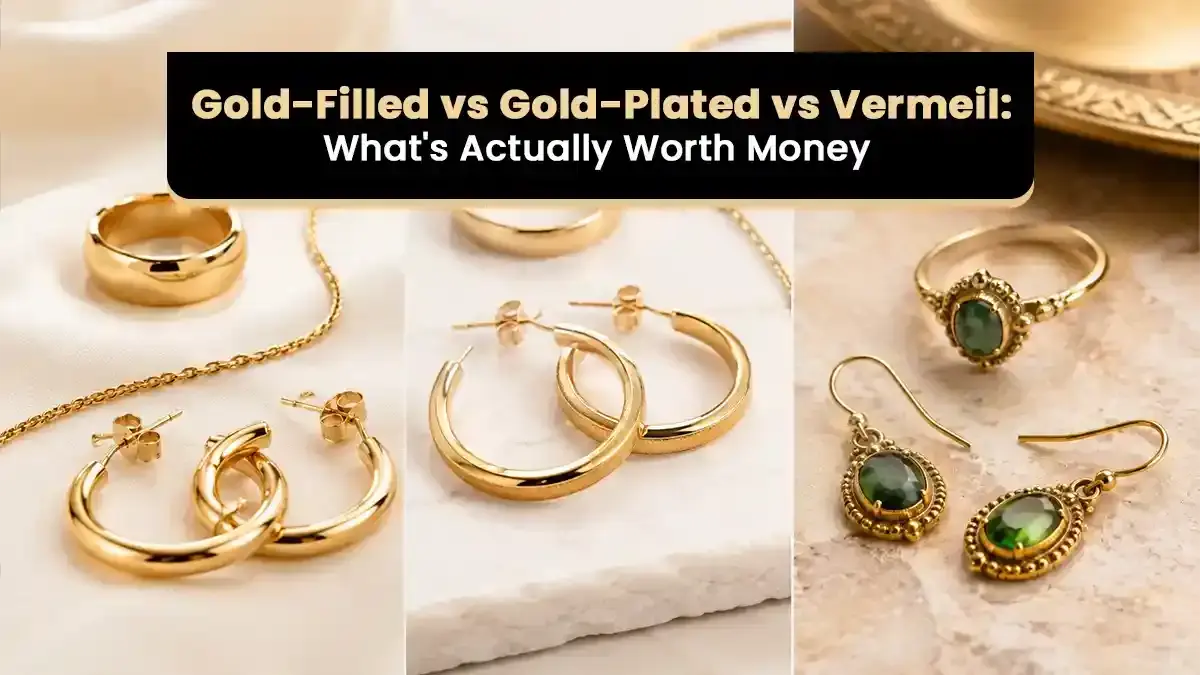
Gold-filled, gold-plated and vermeil get thrown around like they mean the same thing. The value gap between them is enormous. One holds real gold you could actually resell. Another is closer to costume jewellery that tarnishes within a year. Want to know what gold-filled jewelry is and how it differs from the other two? The labels alone won’t tell you. This guide breaks down gold content, durability and resale value for each type. You get a straight answer, not just definitions.
Gold-Filled vs Vermeil vs Plated: Quick Comparison
| Type | Gold content | Base / build | Lasts | Resale value |
|---|---|---|---|---|
| Solid gold | 100% (in karat terms, e.g. 14k = 58.3%) | Solid metal throughout | A lifetime, generations | High, full scrap value |
| Gold-filled | At least 5% by weight (1/20 standard) | Real gold layer mechanically bonded to brass | Decades with care | Modest but real |
| Gold vermeil | Thin electroplate, 2.5+ microns, 10k+ gold | Gold over sterling silver (925) | Several years with care | Low, mostly silver value |
| Gold-plated | Under 0.05% by weight, often ~0.5 micron | Gold electroplated onto brass or copper | Weeks to a couple of years | Essentially none |
Solid gold is the benchmark, but almost nobody wears it daily. Most shoppers really choose between gold-filled, vermeil and plated. That choice comes down to how much actual gold sits under the shine. The table above shows gold content and durability at a glance. The sections below explain why that gap exists and what it means for resale.
What is Gold-Filled Jewelry?
What does gold-filled mean in jewelry? It means a thick layer of real gold, usually 14k, bonded to a brass core with heat and pressure. Makers don’t just dip or electroplate it on. That bonding process separates gold-filled from every other non-solid gold type on this list.
By US federal law (FTC), gold-filled jewellery must contain at least 5% gold by weight. Jewellers often write this as 1/20, meaning the gold layer makes up one-twentieth of the total weight. That might sound modest. In practice, it works out to roughly 100 times more gold than a typically plated item. Plated pieces sit under 0.05% gold by weight.
The mechanical bonding matters just as much as the quantity. Heat and pressure fuse the gold layer to the brass base. It becomes part of the metal’s structure instead of sitting on top. This is why gold-filled pieces resist flaking and chipping where plated jewellery can’t. There’s no thin surface coating to rub off with everyday wear.
You can usually confirm gold-filled jewellery by checking for a stamp reading “1/20 14K GF” or similar. A genuine piece should carry that stamp. Checking it is one of the fastest ways to verify what you’re buying or selling. Do it before you assume a piece has real resale value.
What is Gold Vermeil Jewelry?
To make gold vermeil (pronounced “ver-may”), a jeweller electroplates gold onto a sterling silver base rather than brass or copper. In the US, the FTC standard calls for a gold layer of at least 2.5 microns. The gold itself must be at least 10 karat. That layer runs meaningfully thicker than standard plating, which lifts vermeil a genuine step above ordinary gold-plated pieces.
The base metal is the real difference here. Sterling silver (925) is a precious metal in its own right. Vermeil carries value even before you count the gold layer on top. That matters for two reasons. Silver is generally kinder to sensitive skin than the brass or copper under plated pieces. It also means a vermeil piece keeps some worth even if the gold surface wears thin.
One caveat if you buy internationally: standards vary by country. Canada, for instance, allows a gold layer as thin as roughly 1 micron, well below the US 2.5-micron minimum. So a “vermeil” stamp doesn’t guarantee the same thickness everywhere.
What is Gold Plated Jewelry?
A jeweller electroplates a microscopically thin layer of gold onto a base metal like brass or copper. That layer often runs around 0.5 micron and under 0.05% of the piece’s total weight. For perspective, it’s roughly 100 times thinner than the gold layer in a gold-filled piece.
Because the layer is so thin, it doesn’t hold up to daily wear. Most plated pieces start showing brass or copper within weeks to months. Friction points like ring shanks and clasps go first. Moisture and body chemistry speed this up. Many wearers also notice the well-known “green skin” effect as the base metal reacts and tarnishes against the skin.
It’s worth being straight about this one. Gold-plated jewellery is essentially fashion or costume jewellery. That’s fine if you know what you’re buying and want an affordable piece for occasional wear. It isn’t an investment, and it won’t hold meaningful resale value down the line.
Which is Actually Worth Money?

So is gold-filled jewelry worth anything? Yes, and it’s the clear answer of the three. Gold-filled jewellery keeps real gold content, roughly 5% of its total weight. That gives it genuine scrap and resale value beyond the craftsmanship. It won’t fetch what solid gold does. Still, it’s the only one of the three non-solid options a buyer weighs on gold content at all.
Vermeil sits in the middle. It does contain real gold, plus a sterling silver base that carries its own value. But the gold layer is thin, so resale leans more on the silver underneath than the gold on top. It’s a step above plated, not a real rival to gold-filled for long-term value.
Gold-plated jewellery, by contrast, has essentially no resale value. The gold layer is too thin to register by weight. Once it wears through, what’s left is brass or copper. A buyer checking plated jewellery for metal content simply won’t find much.
To be honest about all three: none rivals solid gold as an investment. You shouldn’t buy any of them mainly for resale. But say you’re choosing between the three for everyday wear and want something that holds value better. Gold-filled is the clear pick. It’s the one a gold buyer can actually put a number on.
How Long Does Each Type Last?
How long does gold-plated jewelry last? With regular wear, expect anywhere from a few weeks to about two years before the base metal shows through. It depends on how often you wear the piece and where it sits on the body.
Vermeil holds up longer. With reasonable care, a vermeil piece can last several years, since its thicker gold layer takes longer to wear away. Gold-filled goes further still. Makers bond the gold layer instead of coating the surface. So gold-filled jewellery can last decades, often a lifetime, with proper care.
The gap comes down to two things: how thick the gold layer is and how the gold attaches. A thin electroplated coating has less material to lose before the base metal shows. The gold in a gold-filled piece is part of its structure, not a coating on the surface.
A few everyday factors affect all three. Moisture, chemicals like perfume or chlorine, and your own body chemistry can all speed up wear. Store pieces dry, and take them off before you swim or shower, whatever the type.
How to Tell Them Apart When Buying
The fastest way to tell what you’re buying is to check the hallmark stamp. Gold-filled pieces should read “1/20 14K GF” or similar, spelling out both the karat and the gold fraction by weight. Vermeil pieces usually carry a “925” stamp for the sterling silver base, sometimes with a vermeil mark too. Plated pieces often read “GP” or “gold plated”. Cheaper items sometimes skip the stamp entirely, which is its own signal.
Price is a useful second check. Solid gold and gold-filled pieces cost much more to produce than plated ones. So a piece priced like costume jewellery is unlikely to be genuinely gold-filled. When in doubt, ask the seller what the piece is made of and request documentation.
One specific warning: on marketplaces like Etsy and eBay, sellers sometimes mislabel plated pieces as “gold-filled”. Always check the stamp yourself rather than trusting the listing title.
Frequently Asked Questions
Yes. Gold-filled jewellery contains at least 5% real gold by weight, mechanically bonded to a brass core, which gives it genuine scrap and resale value. It will not match the value of solid gold, but compared with vermeil and gold-plated jewellery, it contains significantly more gold and is the only option that buyers will meaningfully weigh for its gold content.
Gold-plated jewellery typically lasts from a few weeks to around two years with regular wear, depending on how often it is worn and how well it is cared for. The thin electroplated gold layer, often less than 0.05% gold by weight, gradually wears away at high-friction areas such as rings, clasps, and chains, exposing the brass or copper underneath.
Not when it comes to durability and resale value. While gold vermeil has a sterling silver base and a thicker layer of gold than standard plating, gold-filled jewellery contains substantially more real gold by weight and features a mechanically bonded gold layer. This makes it more durable and generally more valuable.
Gold-filled jewellery is highly resistant to tarnishing because its thick gold layer is permanently bonded to the base metal. Gold vermeil can tarnish over time as the gold coating wears away and the sterling silver underneath becomes exposed. Proper storage and regular care can help extend the life of both types of jewellery.