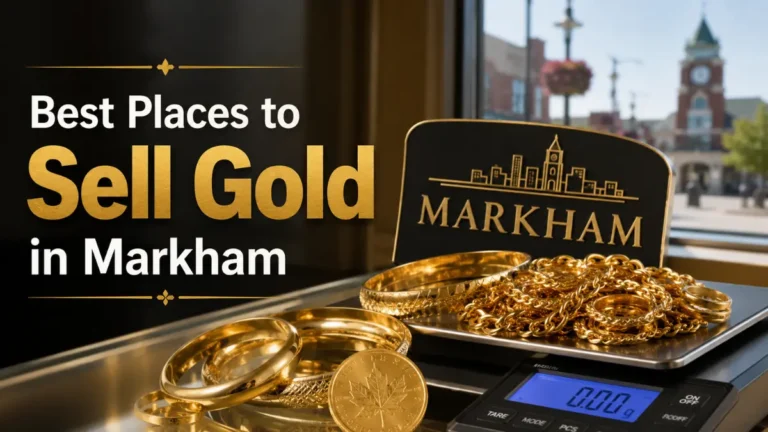

If you are looking for the best places to sell gold jewelry in Toronto, the hardest part is not finding a buyer. It is knowing which buyer will actually pay you a fair price. Toronto has hundreds of gold buyers, from bullion dealers on Bay Street to neighbourhood pawn shops and mall jewellers, and the payout on the exact same chain can swing anywhere from roughly 40% to 99% of its gold value depending on who you walk in to see. On a single piece, that gap can be hundreds of dollars.
This guide compares the main types of gold buyers in Toronto side by side, what to realistically expect from each, and the concrete steps that help you walk out with the highest possible payout, without getting lowballed or caught out by a bad actor. It is a comparison, not a sales pitch for any one shop.
What Is Gold Worth in Toronto Right Now?
Before you compare buyers, it helps to understand what your gold is actually worth. Every fair offer starts from the spot price — the live, global market rate for pure gold, quoted per troy ounce and easily converted to a per-gram figure in Canadian dollars. Spot is the raw benchmark before any buyer’s margin, refining cost, or profit is taken out. No walk-in buyer pays 100% of spot on jewellery, but the best ones come close, and knowing the number is your single strongest piece of leverage.
Your jewellery is almost never pure gold, so its value depends on its karat — the proportion of actual gold in the metal. 24K is pure gold; 18K is 75% gold; 14K is about 58.3%; and 10K, common in Canadian jewellery, is 41.7% gold. A buyer weighs each piece, multiplies the weight by the gold content for that karat, and applies their payout rate against the current spot price. That is the whole calculation.
Because spot moves every day, treat any per-gram figure as a snapshot. Check a neutral market-data source such as Kitco for the live rate on the day you plan to sell.
Where to Sell Gold Jewelry in Toronto: Comparing Your Options
This is where the payout gap lives. When people search for gold buyers near me or cash for gold near me in Toronto, they get a mix of four very different business models, each with its own economics. Here is what separates them.
Licensed Bullion Dealers & Refiners
Bullion dealers and refiners are, for most sellers, the best place to sell gold jewelry in Toronto if your goal is the highest price. Their business is built on volume and precise, transparent pricing rather than on reselling your ring as a retail item. Because they refine or wholesale the metal, they can pay much closer to spot, commonly in the 85–99% range depending on quantity and purity. Reputable dealers test and weigh your gold in front of you, show you the live spot price, and explain exactly how they reached the offer. The trade-off is that they care about the gold content, not the sentimental or brand value of the piece, so an intricate designer bracelet is valued by its metal, not its craftsmanship.
Jewellery Stores
Many Toronto jewellery stores buy gold directly from the public, and they are a reasonable middle option. Payouts typically land somewhere around 55–75% of the gold value, though this varies widely. A jeweller may pay more than a bullion dealer for one specific reason: if your piece has genuine resale value as jewellery, a branded, designer, or antique item in good condition, a store that can resell it may factor in that retail upside. For plain scrap, broken chains, or single earrings, though, a jeweller usually pays less than a dedicated bullion buyer, because they still have to send that metal off to a refiner themselves. For jewellery specifically, see how to sell gold jewellery for a transparent, tested offer.
Pawn Shops
Pawn shops are the most convenient and the most expensive way to sell, in terms of what you give up. They are easy to find across Toronto, offer instant cash, and rarely ask questions about the piece. But their offers are typically the lowest, often in the 40–60% range of the gold value, because their model is built around quick liquidity and reselling at a markup. A pawn shop is worth considering if you need cash immediately and the piece is small, but for anything of real weight or karat, you are almost always leaving money on the table compared with a dealer.
Online & Mail-In Gold Buyers
Online and mail-in buyers let you sell gold jewelry near me without leaving home: you request a kit, mail your gold, and receive an offer after they assess it. Some are legitimate and competitive; the category’s weakness is that you lose the ability to test and weigh in front of the buyer, and getting your items back if you reject the offer can be slow. If you use a mail-in service, choose an established, insured one, photograph and weigh everything before you ship, and confirm their return policy in writing. For most Toronto sellers, a reputable local buyer you can stand in front of is the safer choice.
Here is how the four options compare at a glance:
| Buyer Type | Typical Payout (% of gold value) | Speed | Best For |
| Licensed Bullion Dealer | 85–99% | Same day | Highest price; scrap, bulk, or high-karat gold |
| Jewellery Store | 55–75% | Same day | Branded, designer, or resaleable pieces |
| Pawn Shop | 40–60% | Instant | Fast cash on small pieces |
| Online / Mail-In | Varies widely | 3–10 days | Convenience; sellers without a local option |
Payout ranges are industry-typical and vary by dealer, quantity, purity, and market conditions. Always confirm the specific rate on the day.
How to Get the Best Price for Your Gold
Once you know who pays what, these five steps do the most to protect your payout.
1. Check the live spot price first
Look up the current gold spot price in Canadian dollars before you contact anyone. This single number turns you from a hopeful seller into an informed one. When a buyer makes an offer, you can immediately gauge whether it is 90% of the metal value or 50%. Sellers who quote the spot price back to a buyer are far less likely to be lowballed, because the buyer knows you are paying attention.
2. Separate your jewellery by karat
Sort your pieces into 10K, 14K, 18K, and higher before you go. Mixing karats invites a buyer to weigh everything together and pay you the lowest karat rate across the whole lot. Most gold is stamped with its karat (10K, 14K, 417, 585, 750). Grouping it yourself ensures each piece is valued at its true content and makes the buyer’s assessment faster and more transparent.
3. Weigh your pieces before you go
Use a small digital scale to record the weight of your gold in grams at home. You do not need jeweller-grade precision, just a reference. Knowing the approximate weight lets you sanity-check the buyer’s scale and their math on the spot. If your numbers and theirs are wildly different, that is your cue to ask questions.
4. Get at least two or three quotes
This is the highest-leverage step of all. Offers on the same piece genuinely vary by hundreds of dollars, so never sell to the first buyer without a comparison. Get quotes from at least two or three different buyer types, for example a bullion dealer and a jeweller. Many buyers will match or beat a competitor’s written offer, so a second quote often pays for itself in minutes.
5. Bring valid government-issued ID
If you want to sell gold for cash in Toronto, bring a valid, government-issued photo ID, and expect same-day payment from any legitimate buyer once the deal is agreed. ID is not optional paperwork you should try to avoid; as covered below, it is a legal requirement, and a buyer who skips it is a warning sign, not a convenience.
Red Flags to Watch For in Toronto
A fair gold sale is transparent from start to finish. Watch for these warning signs, any one of them is a reason to walk away.
● The buyer won’t test or weigh your gold in front of you. Legitimate buyers assess your gold openly and let you watch. Testing or weighing in a back room is a red flag.
● Vague or unexplained ‘processing fees’. A fair offer is the offer. Surprise deductions for ‘refining’, ‘handling’, or ‘processing’ that were never mentioned up front quietly shrink your payout.
● No request for ID. In Ontario, buyers are legally required to verify identity and keep transaction records. A buyer who doesn’t ask for ID is operating outside the rules, which tells you how they treat everything else.
● High-pressure, decide-now tactics. ‘This price is only good right now’ is designed to stop you from getting a second quote. A reputable buyer is happy for you to compare offers.
That ID requirement is worth understanding properly. Businesses that buy and sell precious metals in Canada must verify customer identity and keep detailed transaction records under federal rules administered by FINTRAC, and in Toronto, gold buyers must also hold a municipal Precious Metal Shop licence from the City of Toronto. If a buyer isn’t following these basics, that alone tells you to sell elsewhere.
Is 2026 a Good Time to Sell Gold in Toronto?
Gold has traded in a historically elevated price environment in recent years, which means jewellery sitting in a drawer may be worth considerably more today than when it was bought or inherited. That is the factual backdrop; where the price goes next is something no one can reliably predict, and this guide won’t try.
The more useful way to think about it is personal rather than speculative. If you have gold you no longer wear, need to liquidate, or simply want to convert to cash, the current environment is favourable and the decision comes down to your own timing and needs, not to guessing the top of the market. Sell when it makes sense for you, and focus your energy on getting a fair price rather than on timing the market perfectly.
Conclusion
When it comes to gold buyers in Toronto, the hierarchy is consistent: licensed bullion dealers usually pay the most, pawn shops pay the least, and jewellers and online buyers sit in between, so the single biggest factor in your payout is knowing which type you are walking into. Check the live spot price, sort your gold by karat, weigh it, and get at least two or three quotes before you sell. Do that, and you turn a potential lowball into a fair, transparent sale.
Frequently Asked Questions
For the highest payout, a licensed bullion dealer or refiner is usually the best place, typically paying 85–99% of the gold’s value versus 40–60% at a pawn shop. If your piece has genuine designer or antique resale value, a jewellery store may compete. The reliable approach is to get two or three quotes and compare.
Pawn shops generally pay the least, often around 40–60% of the gold’s value, because their model is built on fast cash and resale. Licensed bullion dealers commonly pay 85–99%. On a heavier or higher-karat piece, that difference can add up to hundreds of dollars, which is why comparing buyer types matters so much.
You need valid, government-issued photo identification, such as a driver’s licence or passport. Ontario gold buyers are legally required to verify your identity and record the transaction under federal FINTRAC rules and municipal licensing. This protects both sides, and a buyer who doesn’t ask for ID is not operating within the rules.
Yes. Broken chains, single earrings, bent rings, and tangled scrap are all sellable, because their value comes from gold content, not condition. In fact, scrap and broken pieces are often best sold to a bullion dealer, who values them purely by weight and karat rather than by whether they can be resold as jewellery.