
More Canadians than ever are stripping away assorted pieces of jewelry, coins and scrap and cashing them in with gold prices nearing historic levels. Unfortunately, high prices also attract opportunists—pop-up “cash-for-gold” stands and unscrupulous buyers who are hoping that the seller is not aware of how much their gold is worth. Knowing how to sell gold the right way protects you from both. Whether you’re selling in Canada, this guide will help you find a legitimate buyer, understand some of the common scams, and leave with a fair and honest payment.
What Selling Gold Actually Involves
Before you approach a buyer, it helps to understand the basics behind selling gold, since the same fundamentals apply whether you’re offloading a single ring or a small collection of coins.
Types of gold people sell: Most of the gold people sell is fine jewelry (rings, chains, bracelets), gold coins or bullion, gold bars or gold dust (broken chains, single earrings or dental gold). They are all valued in a similar manner, with coins and bars possibly having additional collector or bullion values.
How a buyer values your gold: A legitimate buyer will use three factors when determining the value of your gold: The first factor is the karat (purity) of the gold, the second factor is the weight (usually in grams or troy ounces) of the gold, and the third factor is the current live gold price. If someone is giving you a number without checking all three, he or she doesn’t have your best interests in mind.
Where to Sell Gold: Comparing Your Options
There’s no single best place to sell gold — the right option depends on how much you value trust, convenience, and payout. Here’s how the main buyer types stack up.
Bullion dealers specialize in gold and typically offer the most transparent, spot-price-linked payouts, especially for coins and bars, though they may be less interested in low-purity jewellery.
Jewellers can offer good value for wearable pieces, particularly if they plan to resell rather than melt the item, but quality varies widely by shop.
Pawn shops offer fast cash and are heavily regulated with ID requirements, but payouts tend to run lower since they price in resale risk.
Cash-for-gold and mail-in services are convenient but carry the highest scam risk, since you often lose the ability to watch testing and weighing happen.
Refineries pay closer to true melt value for larger quantities of scrap gold, but usually aren’t practical for a single small item.
| Buyer type | Payout potential | Transparency | Best for |
| Bullion dealers | High | High | Coins, bars, bullion |
| Jewellers | Medium–High | Medium | Wearable jewellery pieces |
| Pawn shops | Medium | Medium | Fast, small, in-person sales |
| Cash-for-gold / mail-in | Low–Medium | Low | Convenience, with caution |
| Refineries | High (bulk) | High | Larger volumes of scrap gold |
How to Identify a Legitimate, Reputable Gold Buyer
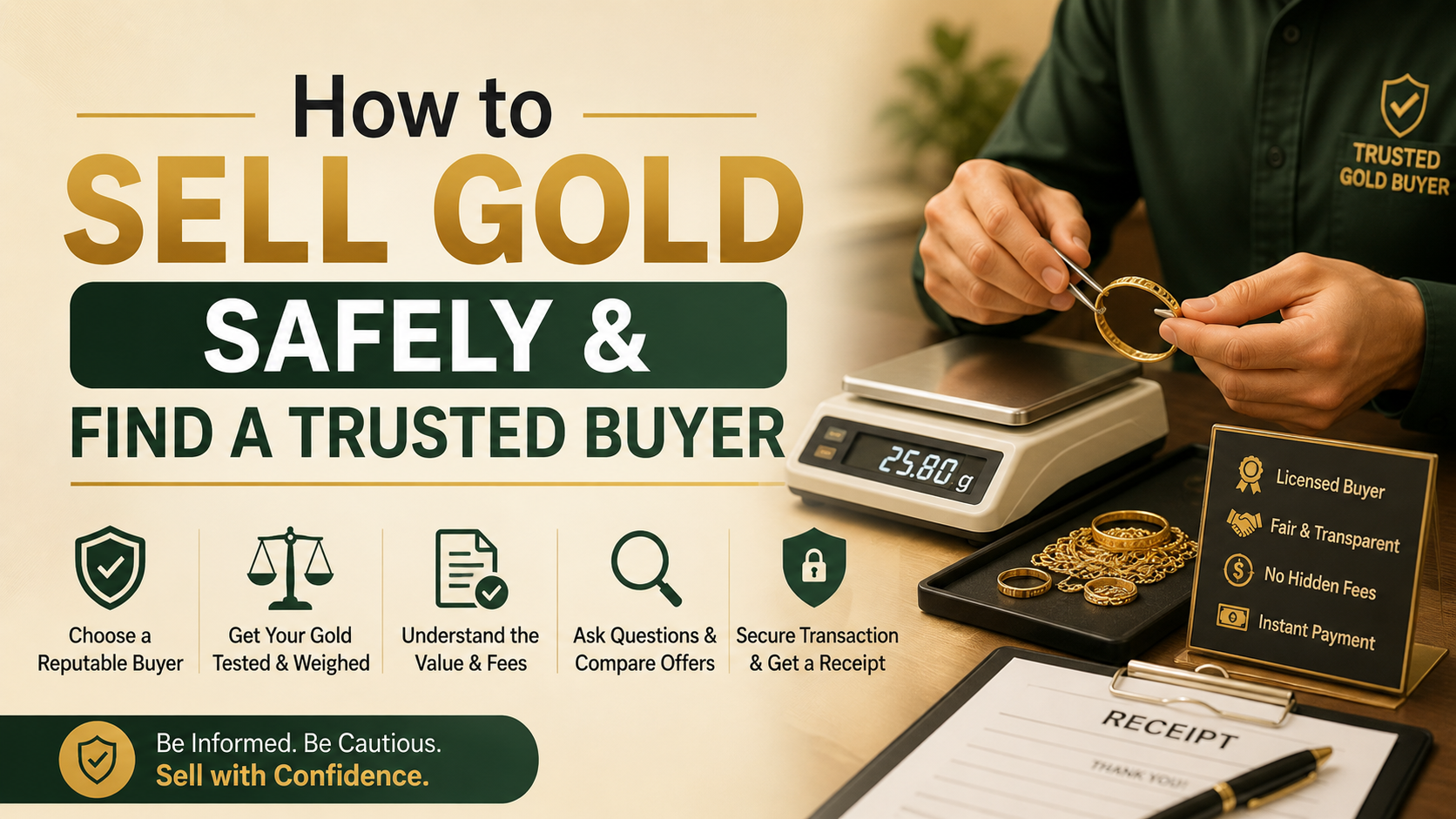
Before you hand over a single piece, run through this checklist to confirm you’re dealing with a legitimate gold buyer.
Check business registration and licensing
A legitimate buyer should be a registered business, and in many provinces, second-hand and precious metal dealers require a specific license or permit. Ask for their business number or license, or look it up yourself before you go in.
Look for a physical, established storefront
A permanent address with a track record is a strong trust signal. Be cautious of pop-up kiosks, hotel-room “gold parties,” or buyers with no fixed location, since they’re harder to hold accountable if something goes wrong.
Read independent reviews and reputation signals
Check Google reviews, the Better Business Bureau, and local business listings. Look past star ratings to the actual comments—specifically whether people mention fair pricing, transparency, and professionalism.
Confirm transparent testing and weighing in front of you
A reputable buyer tests and weighs your gold, where you can see the entire process on a visible, calibrated scale. If testing happens in a back room, out of view, treat that as a serious warning sign.
Expect proper ID, receipts and paperwork
Legitimate buyers are required to record ID for regulatory purposes and will always issue a detailed, itemized receipt showing weight, karat, and price paid. No receipt means no protection if a dispute comes up later.
Red Flags and Common Gold-Buying Scams to Avoid
Most gold-buying scams follow recognizable patterns. Watch for these, and you’ll avoid the vast majority of bad actors.
Pressure tactics and today only offers
Urgency is a classic manipulation tactic. A genuine offer based on the live spot price doesn’t need to expire in the next ten minutes. If you feel rushed, walk away and get a second opinion.
Rigged scales or testing done out of sight
If you can’t watch your gold being weighed and tested, you can’t verify the result. Ask to see the scale’s calibration certificate, or simply choose a buyer who tests everything in plain view.
Vague or refused written quotes
A trustworthy buyer will happily put karat, weight, and price per gram on paper before you agree to sell. If a buyer talks in vague terms and won’t commit anything in writing, treat that as a dealbreaker.
Lowball offers far below a fair margin
Every buyer takes a margin off spot price, but if an offer feels dramatically low, it probably is. Compare against the day’s live gold price and get at least one more quote before accepting.
No fixed address, cash-only, no receipt
A buyer who insists on cash-only deals, has no verifiable address, and won’t issue a receipt is offering you zero recourse. These are the clearest signs to walk away immediately and take your gold elsewhere.
How to Test and Verify Your Gold Before Selling
Understanding how to test gold yourself gives you a sanity check before you ever step into a buyer’s shop.
Reading hallmarks and karat stamps: Most gold jewellery is stamped with a karat mark (10K, 14K, 18K, 24K) or a numeric fineness stamp (417, 585, 750, 999). These stamps are a starting point, not a guarantee, since counterfeit stamping does happen.
Simple at-home checks vs. a professional assay: Basic checks like a magnet test (gold isn’t magnetic) or a jeweler’s loupe inspection can flag obvious fakes, but they can’t confirm true purity. For anything valuable, a professional assay or acid/electronic test at a reputable dealer is the only reliable verification.
Weighing correctly: Gold is typically weighed in grams, troy ounces, or pennyweight, and these units aren’t interchangeable with everyday ounces. A kitchen scale won’t cut it—insist on a calibrated jewelry or precious-metals scale for anything you’re planning to sell.
Understanding Fair Pricing and How Much You Can Get
The real answer to how much can you sell gold for starts with understanding the method buyers use, not a fixed percentage.
How the live gold price (spot) works: Spot price is the current global market price for one troy ounce of pure (24K) gold, updated constantly throughout the trading day. It’s the baseline every legitimate offer should reference, and you can check it against sources like the Royal Canadian Mint for current bullion pricing context.
Why you receive less than spot: No buyer pays the full spot price, since they need to cover refining, resale risk, and their own margin. A fair buyer’s discount off the spot should be reasonable and explainable—ask them directly how their offer relates to the day’s spot price.
A simple worked example: Say you have a 14K gold ring weighing 10 grams. 14K gold is roughly 58.3% pure, so the pure gold content is about 5.83 grams. Multiply that by the day’s spot price per gram, then expect a fair buyer’s offer to land at a reasonable discount off that pure-gold value, not off the ring’s full weight.
Get the Best Offer on Gold Jewellery
A few practical habits make a real difference to what you’ll be offered for your pieces.
Get multiple quotes and compare on the same day, since spot price shifts daily and comparing quotes gathered days apart isn’t a fair test.
Separate items by karat before you go, since mixing 10K and 18K pieces together can make it harder to verify you’re being paid correctly for each.
Know your walk-away number before you sit down with a buyer—a rough sense of your gold’s pure weight and the day’s spot price gives you the confidence to decline a lowball offer without hesitation.
Final Checklist Before You Sell
- Confirm the buyer is registered, licensed, and has a real storefront
- Read recent independent reviews, not just star ratings
- Watch your gold being tested and weighed in person
- Get a written quote referencing the live spot price
- Compare at least two offers before deciding
- Keep your itemized receipt and ID confirmation
Choosing a transparent, established, licensed buyer is the single biggest factor in getting a fair deal—take the extra ten minutes to verify before you sell.
Frequently Asked Questions
Look for business registration or a required precious-metals license, a permanent physical storefront, positive independent reviews, and a willingness to test and weigh your gold in plain view while providing a written, itemized receipt.
You’ll typically receive a discount off the pure-gold value calculated from spot price, since buyers factor in refining costs, resale risk, and their margin. A fair buyer can explain that discount clearly when asked.
Watch for high-pressure “today only” tactics, testing done out of your sight, refusal to give a written quote, offers well below fair market value, and buyers with no fixed address or receipt process.
It depends on what you’re selling: bullion dealers tend to offer the most transparent pricing for coins and bars, jewelers can be strong for resalable pieces, and pawn shops offer speed but usually lower payouts.
Start by checking for a karat or fineness hallmark, then use simple checks like a magnet test as a first pass. For anything valuable, only a professional assay at a reputable dealer confirms true purity.
Yes—comparing at least two quotes on the same day, when the spot price is consistent, is the easiest way to confirm you’re getting a fair offer rather than a lowball one.