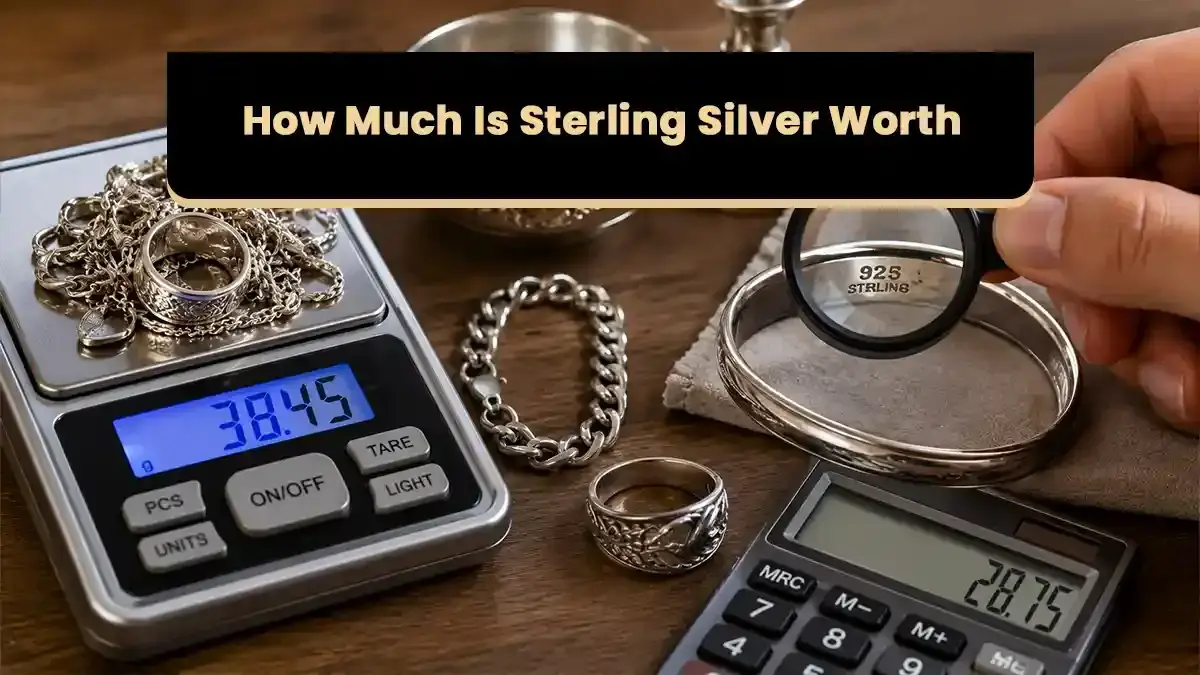
That inherited box of cutlery, the drawer of tangled 925 chains, the tarnished serving tray at the back of a cabinet: at some point the question turns practical. How much is sterling silver worth, actually? There are two honest answers, and they are not the same number. One is the metal value: what the silver itself is worth by weight, tracked against the live silver price. The other is what a specific piece can fetch once its brand, pattern, or age is factored in. This guide breaks down both, in Canadian dollars, using today’s sterling silver price so you know exactly what you are holding before deciding where or how to sell it.
How Much Is Sterling Silver Worth Today? (925 Silver Price in CAD)
Sterling (925) silver is worth about 92.5% of the live silver price by weight. As an example, when spot silver sits near CAD $82.34 per troy ounce, that works out to roughly CAD $2.45 per gram of sterling silver melt value, though a buyer will typically pay a little under that figure. The 925 silver price moves every day with the market, so the number matters most on the day you sell.
Because the spot price changes constantly, treat every dollar figure in this guide as a worked example rather than a fixed rate. Check today’s live silver price before you calculate, then use the method below to turn that rate into a real number for your own pieces, whether it is a single ring or a full cutlery set.
What Sterling Silver and 925 Actually Mean
Sterling silver is an alloy: 92.5% pure silver combined with 7.5% of another metal, usually copper, sometimes zinc or nickel, added for strength since pure silver is too soft to hold its shape in jewellery or flatware. You will see this expressed a few ways: “925,” “Sterling,” “STER,” or “.925,” all marks for the same standard.
The detail most guides skim past: solid sterling and silver plated are not the same thing, and the difference decides the sterling silver value. Plated pieces carry only a thin layer of silver over a base metal like brass or nickel, so their melt value is close to nothing. Before calculating anything, confirm what you actually have.
Look for the hallmark first: inside a ring band, near a clasp, or stamped into the back or handle of flatware. No mark, a magnet that sticks (sterling is not magnetic), or wear showing a different colour underneath are all signs a piece may be plated. When in doubt, a jeweller with an XRF tester can confirm it in minutes.
The Two Values: Melt Value vs. Market Value
Once you know you are holding solid 925, there are two numbers to think about. Melt value, also called scrap value, is just the silver content: weight times purity times the current silver price, nothing more. It is the baseline every buyer works from, regardless of who made the piece. Market value is different: it is what a finished piece can sell for when something beyond the raw metal adds worth, a recognised maker, a discontinued pattern, fine craftsmanship, age, or a complete set rather than odd pieces.
Most everyday sterling, a plain chain, a worn ring, a handful of mismatched spoons, trades close to the sterling silver melt figure. A smaller share is worth meaningfully more, and that distinction decides how you should approach selling it, which we cover shortly.
How to Calculate the Melt Value of Your Sterling Silver (CAD)
You do not need a paid silver value calculator to do this. The formula is simple:
weight (grams) × 0.925 × CAD silver price per gram = melt value
Spot silver is quoted per troy ounce, not per gram, so there is a short conversion first. One troy ounce equals about 31.10 grams. If spot silver is, for example, CAD $82.34 per troy ounce, divide that by 31.10 to get the pure-silver price per gram, about CAD $2.65. Multiply by 0.925 to account for sterling’s purity, and you land at roughly CAD $2.45 per gram of sterling silver melt value. From there, it is just that number times the weight of silver you are holding. That is the whole silver melt value calculator method, done by hand.
Example 1: a 25 g sterling chain
25 g × CAD $2.45/g ≈ CAD $61.25 in melt value. That is the raw silver value, before any buyer’s margin.
Example 2: a 600 g box of sterling cutlery
600 g × CAD $2.45/g ≈ CAD $1,470 in melt value, assuming the whole box is confirmed solid sterling and not a mix of plated serving pieces.
As a quick reference at that example rate, here is what different weights come to. Use it as a sterling silver calculator shortcut, then adjust for the live rate on the day:
| Weight of Sterling Silver | Approx. CAD Melt Value |
| 10 g | $24.50 |
| 50 g | $122.50 |
| 100 g | $245.00 |
| 300 g | $735.00 |
| 600 g (typical cutlery box) | $1,470.00 |
This table moves with the silver price, so treat it as an example, not a fixed rate. Two practical notes before you weigh anything: take stones, non-silver clasps, and knife blades (often stainless, not sterling) off your total, and never mix plated pieces into the weight since they will inflate a sterling silver worth figure that is not really there.
What a Buyer Actually Pays (Sterling Silver Scrap Price)
Melt value is the ceiling, not the offer. The sterling silver scrap price you are quoted will typically land somewhat under your calculated melt value, and that is normal, not a red flag on its own. A buyer has to test and confirm purity, cover refining and handling costs, and take on some price risk between the offer and the eventual resale, so a margin below melt is how the business works.
As a general guide, market offers often fall somewhere in the 60 to 85% range of melt value, trending higher for larger, cleaner, easy-to-verify lots and lower for small or mixed items that take more work to sort. This is not a fixed rate and it varies by buyer and by volume.
The real value of knowing your sterling silver melt value is not to expect it as your payout. It is your reference point: it is what lets you tell a fair offer from a lowball one, and it is worth doing the maths before you walk in anywhere.
When Sterling Silver Is Worth More Than Melt (Brands, Antiques, Birks & Flatware)
Not everything sterling should be sold as scrap. Once a piece carries a recognised name, a notable pattern, or genuine age, it can be worth more sold whole than melted down.
Brand and design premium
Jewellery from makers like Tiffany, Georg Jensen, or Pandora often sells above melt to a buyer who values the design and maker’s mark, not just the silver content.
Birks silverware, specifically
In Canada, Henry Birks & Sons sterling flatware and hollowware carries genuine recognition. A Birks pattern, kept as a set, can fetch more than scrap value precisely because it is Birks, and anyone asking where to sell Birks silverware is usually better served getting it valued as a set than weighed as scrap.
Cutlery sets more broadly
What drives the number is the pattern, the maker’s hallmark, and how complete the service is. A full set in its original box beats the same weight in odd, mismatched pieces. One habit to avoid: do not polish a set aggressively before selling. A bit of patina or honest wear does not hurt value the way over-polishing or scratching can.
The rule of thumb worth remembering: melt the broken, mismatched, or plated pieces, and get the branded, antique, or complete sets properly valued before you decide to sell sterling silver.
Where and How to Sell Sterling Silver in the GTA
Once you know what you are holding and roughly what it is worth, the honest options for where to sell sterling silver in the Greater Toronto Area come down to a few channels, each with a real trade-off.
- Local precious-metal buyers and jewellers tend to offer same-day cash and a straightforward, in-person evaluation, good for both scrap and better pieces, though it pays to compare more than one offer.
- Pawnbrokers are fast and convenient but sometimes prioritise turnaround over top dollar.
- Refiners suit large lots, like a full box of mixed flatware, better than single pieces.
- Online marketplaces can outperform local offers for branded or collectible items like Birks sets or designer jewellery, at the cost of more effort, time, and shipping risk.
If you are searching for where to sell silver cutlery near me, a local GTA buyer is usually the simplest starting point: bring it in, get it weighed and tested in front of you, and walk away with a same-day, no-obligation quote. It is worth checking today’s silver price before you go, so you can compare what you are offered against your own numbers.
Conclusion
Working out how much sterling silver is worth comes down to two steps: calculate your CAD melt value using today’s 925 silver price, then decide whether a piece belongs in the scrap pile or deserves to be sold as itself, particularly if it is Birks, branded, or a complete set. Either way, get more than one quote before you sell. If you are ready, GTA Gold Buyers offers a free, no-obligation quote at our Whitby or Burlington locations, and it is worth checking today’s live silver price first so you know exactly what you are comparing an offer against.
Frequently Asked Questions
At today’s CAD spot price, sterling silver (925) works out to roughly CAD $2.45 per gram in melt value. Because silver prices fluctuate daily, it is best to calculate the current value close to the time you plan to sell rather than relying on older estimates.
Many precious metal buyers across the Greater Toronto Area, including Whitby and Burlington, purchase sterling silver cutlery. They typically test and weigh your items on the spot and provide a same-day, no-obligation quote, making them a convenient option for selling everyday silver flatware.
In many cases, yes. Henry Birks & Sons silverware is well regarded, and complete sets in desirable patterns can be worth considerably more than their scrap silver value. It is always recommended to have Birks pieces professionally evaluated as a complete set before selling them for melt.
Melt value represents the theoretical value of the pure silver content. Buyers generally offer less because they account for testing, refining costs, handling, and business margins. Depending on the quantity and quality of the silver, offers commonly range between 60% and 85% of the calculated melt value.